
Short Answer
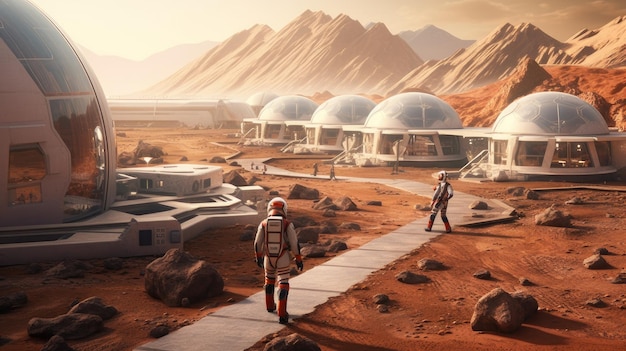
Imagine, if you will, a crimson horizon stretching endlessly across a rust-colored desert, where the air is thin enough to make your lungs ache and the sun hangs like a blood-orange lantern in the sky. This is Mars—a world of contradictions, where the promise of human colonization dances with the specter of ecological collapse. Yet, amid this barren expanse, a humble survivor thrives: the cactus. Could these spiky, sun-worshipping sentinels of the desert be the key to making Mars habitable? Could they, in their quiet, tenacious way, help us turn a dead planet into a living one? The question is as audacious as it is absurd, and yet, it’s one we must ask. After all, if we’re going to call Mars home, we’ll need more than just oxygen tanks and pressurized domes—we’ll need life itself. And what better way to introduce life to a lifeless world than with a plant that laughs in the face of drought?
The Martian Oasis: Why Cacti Might Be Our Cosmic Allies
Mars is a graveyard of failed dreams—its surface a graveyard of dried-up riverbeds, frozen polar caps, and soil that clings to metal like a desperate lover. Yet, within this desolation, there’s a glimmer of hope: extremophiles. These are organisms that thrive in conditions once thought impossible—boiling acid, crushing depths, the void of space itself. And among them, cacti stand out like a neon sign in a blackout. Their superpowers? Water retention so efficient it borders on sorcery, photosynthesis that operates in low light, and a metabolism that slows to a crawl when times get tough. If any plant could survive the Martian night, where temperatures plummet to -73°C (-100°F), it’s a cactus. But survival isn’t colonization. Could they do more than just endure? Could they, in time, reshape an entire planet?
The idea isn’t as far-fetched as it sounds. On Earth, cacti are pioneers, the first to colonize disturbed landscapes, their roots breaking through cracked concrete and their spines piercing the armor of inhospitable soil. On Mars, they could serve as the vanguard of terraforming—a living, breathing army of green (or, more likely, gray-green) revolutionaries. Their shallow, widespread roots could stabilize the regolith, preventing the dust storms that plague the planet. Their ability to sequester carbon dioxide might, over centuries, help thicken the atmosphere, nudging Mars closer to Earth-like conditions. And let’s not forget their aesthetic appeal: a cluster of saguaros rising from the Martian plains would be a sight more inspiring than any human-made structure. Beauty, after all, is a form of hope.
The Thorny Challenge: Why Mars Might Not Be Cactus-Friendly
Of course, the road to a Martian cactus utopia is paved with thorns—literally. The first hurdle is the soil. Martian regolith is a witch’s brew of perchlorates, heavy metals, and a consistency somewhere between powdered glass and volcanic ash. Cacti, evolved for the mineral-rich loam of the Sonoran Desert, would gag on this stuff. Even Earth’s most resilient plants struggle in regolith without extensive remediation. Then there’s the water—or rather, the lack of it. While cacti are masters of drought, they still need *some* water, and Mars’ reserves are locked away in ice caps and underground aquifers. Extracting and distributing it would require infrastructure that doesn’t yet exist. And let’s not forget the radiation. Without a magnetic field, Mars is bombarded by cosmic rays that would fry a cactus faster than a desert sun at noon. Could we shield them? Maybe. But it’s a puzzle we’ve only begun to solve.
Then there’s the question of time. Terraforming isn’t a weekend project. It’s a generational endeavor, requiring patience, adaptability, and a willingness to accept that the first generations of Martian cacti might not survive. We’d need to engineer hardier strains, perhaps through genetic modification, to withstand the planet’s unique horrors. We’d need to create microclimates, using domes or underground habitats to give them a fighting chance. And we’d need to ask ourselves: is it ethical to introduce Earth life to a world that might already harbor its own, unseen ecosystems? The universe has a way of humbling us, and Mars may yet have secrets we’re not ready to face.
From Desert to Desert: The Cactus as a Symbol of Resilience
Perhaps the most compelling reason to bring cacti to Mars isn’t practical—it’s symbolic. In a universe that often feels indifferent, if not outright hostile, to life, the cactus is a defiant middle finger to despair. It grows where nothing else can. It blooms in the face of oblivion. It turns scarcity into abundance. If we’re going to make Mars our second home, we’ll need more than technology. We’ll need that same stubborn, thorny spirit. The cactus doesn’t ask for permission. It doesn’t wait for conditions to improve. It simply *is*. And maybe, just maybe, that’s the lesson Mars needs to learn from us.
There’s something poetic about the idea of a cactus thriving on Mars. It’s a plant that has spent millennia adapting to the harshest environments on Earth, only to be thrust into the harshest environment in the solar system. If it can survive there, what does that say about the resilience of life itself? And if we can nurture it there, what does that say about our own capacity for creation? The cactus is more than a plant. It’s a metaphor. A challenge. A dare. And Mars, with all its desolation, is the perfect stage for its next act.
The Future in Bloom: What Comes Next?
The next step is clear: experimentation. We need to send cacti to Mars—not just as decorative afterthoughts, but as test subjects. Let them grow in controlled environments, under simulated Martian conditions. Let them fail. Let them adapt. Let them show us what’s possible. And when they finally bloom under that alien sky, we’ll know we’ve taken the first step toward making Mars not just habitable, but *alive*.
Of course, there are those who’ll argue that we should focus on Earth first—that our own planet’s wounds are too deep to justify the expense of interplanetary gardening. But that’s a false dichotomy. The technologies we develop for Martian cacti—closed-loop water systems, radiation shielding, soil remediation—could revolutionize agriculture on Earth, especially in the face of climate change. The cactus, in its quiet way, could be the key to saving us both.
So here’s to the spiky pioneers. To the survivors. To the plants that refuse to die. May they find a home on Mars. And may we, in our quest to give them one, rediscover the wonder of life itself.
FAQ
Can cacti survive on Mars?
Cacti have unique adaptations that may allow them to survive in Martian conditions, but significant challenges remain.
What are the main challenges for cacti on Mars?
The primary challenges include the harsh soil composition, lack of water, and high radiation levels.
Why are cacti considered for Mars colonization?
Cacti can aid in terraforming by stabilizing soil and sequestering carbon dioxide.




Leave a Reply