
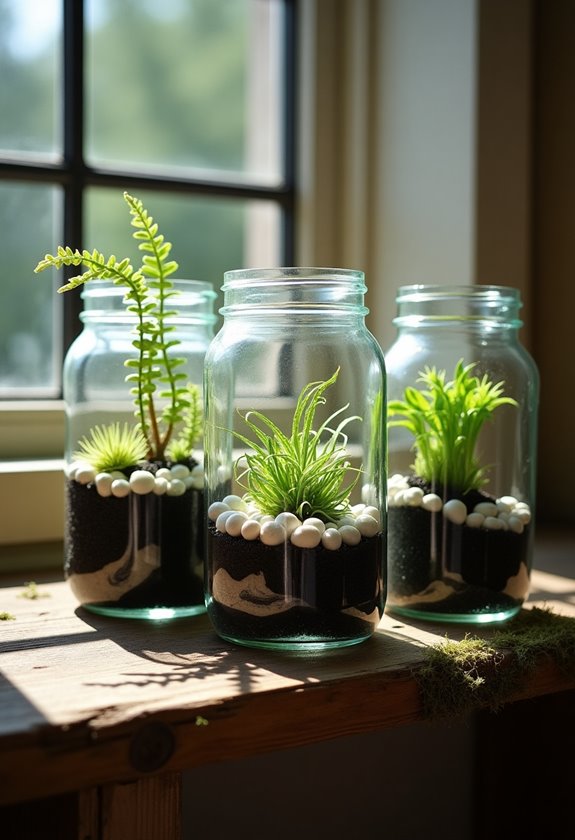
Short Answer
In the delicate ballet of urban living, where square footage is a luxury and every inch demands purpose, the Schlumbergera—affectionately known as the Christmas cactus—emerges as a whisper of wildness, a defiant bloom in the concrete jungle. This epiphytic marvel, with its cascading, segmented arms and radiant blossoms, doesn’t just tolerate confinement; it thrives within it, transforming terrariums into miniature ecosystems of quiet rebellion. For those tethered to small-space gardens, the Schlumbergera is more than a plant—it is a living metaphor for resilience, a testament to nature’s ability to flourish even when hemmed in by the rigid geometries of modernity.
The Schlumbergera: A Botanical Alchemist in Miniature
To understand the Schlumbergera’s allure in terrariums is to appreciate its dual nature: both a survivor of the cloud forests of Brazil and a showstopper in a glass orb. Unlike its terrestrial cousins, this cactus clings to life not in arid sands but in the damp embrace of mossy branches, its flattened stems—phylloclades—acting as both leaf and water reservoir. In a terrarium, these segmented arms become living sculptures, their waxy surfaces catching the light like polished jade, while their pendulous growth mimics the slow, deliberate sway of vines in a rainforest understory. The Schlumbergera doesn’t just occupy space; it redefines it, turning verticality into a canvas for botanical artistry.
Its flowers, too, are a marvel of evolutionary cunning. Bursting forth in a riot of pinks, reds, and whites—often during the darkest days of winter—they are nature’s defiance of seasonal tyranny. In a terrarium, these blooms become constellations, pinpricks of color against the verdant backdrop, their ephemeral beauty a reminder that even in confinement, life insists on making its mark. The Schlumbergera’s ability to bloom in adversity mirrors the spirit of those who cultivate small gardens: a quiet, persistent joy in the face of limitations.
Terrariums as Sanctuaries: Crafting a Microcosm for the Schlumbergera
A terrarium is not merely a container; it is a microcosm, a self-sustaining universe where humidity, light, and substrate conspire to mimic the cactus’s native cloud forest habitat. The key to success lies in replicating the layers of its original environment: a base of coarse gravel or activated charcoal for drainage, a cushion of sphagnum moss to filter impurities, and a top layer of well-draining soil—perhaps a blend of peat, perlite, and a dash of orchid bark to emulate the detritus of decaying leaves. The Schlumbergera, after all, is no desert denizen; it thrives in the breath of moisture-laden air, where the glass walls of a terrarium become its personal greenhouse.
Yet, the terrarium’s magic extends beyond its physical structure. It is a living diorama, a frozen moment in time where the cactus’s growth can be observed in slow motion. The segmented arms stretch outward like the fingers of a hand reaching for the light, their edges softening into a gentle undulation. Over time, the plant may even produce offsets—tiny clones of itself—that dangle like chandeliers, transforming the terrarium into a miniature jungle of interconnected life. This is not mere gardening; it is curation, a deliberate act of creating a tiny, thriving world where the Schlumbergera reigns as both sovereign and storyteller.
The Art of Subtle Domestication: Pruning and Shaping the Schlumbergera
In the wild, the Schlumbergera’s growth is a dance with gravity, its stems arching and cascading in search of light. In a terrarium, however, space is a precious commodity, and unchecked growth can quickly overwhelm the glass confines. Here, the art of pruning becomes a dialogue between gardener and plant—a negotiation of form and function. By trimming back overzealous stems, you encourage bushier growth, coaxing the cactus into a more compact, sculptural shape. The discarded segments need not be discarded entirely; they can be propagated, their potential reborn in new terrariums, a cycle of life that mirrors the plant’s own tenacity.
But pruning is more than a practical necessity; it is an act of intimacy. Each snip is a conversation, a response to the plant’s growth patterns, a way of guiding its story. The Schlumbergera, after all, is not a static ornament but a living entity, its shape evolving with each passing season. In a terrarium, this evolution is laid bare, a slow-motion ballet of adaptation where the gardener becomes both audience and choreographer. The result is a plant that is not merely contained but celebrated, its form a testament to the delicate balance between control and surrender.
Light, Humidity, and the Invisible Threads of Care
The Schlumbergera’s needs are simple, yet precise. It craves bright, indirect light—a sunbeam filtered through a sheer curtain, never the harsh glare of direct noon. In a terrarium, this means positioning it near a window where the light is diffused, or under the gentle glow of a grow lamp, its soft radiance mimicking the dappled light of a forest floor. Too much sun, and the stems bleach; too little, and the blooms wither before they can unfurl. The terrarium’s glass walls amplify this dance, trapping warmth and moisture in a delicate equilibrium.
Humidity, too, is a silent partner in this relationship. The Schlumbergera thrives in the high-humidity environments of its native cloud forests, and the terrarium’s sealed or semi-sealed environment provides just that. A light misting every few weeks—never enough to drown the roots—keeps the air saturated without inviting rot. The gardener must become attuned to the plant’s cues: a slight wrinkling of the stems signals thirst, while a glossy sheen indicates contentment. This is not gardening as conquest, but as collaboration, a partnership where the plant’s needs dictate the rhythm of care.
The Schlumbergera’s blooming cycle is a reward for patience, a burst of color that arrives like a surprise gift in the depths of winter. To coax it into flowering, the plant requires a period of cooler temperatures and reduced light—conditions that mimic the shorter days and chillier nights of its natural habitat. In a terrarium, this can be achieved by moving it to a cooler spot or covering it with a breathable cloth for a few weeks. The result is a spectacle of color, a fleeting but glorious rebellion against the monotony of the season.
The Terrarium as a Mirror: Reflections on Small-Space Living
To grow a Schlumbergera in a terrarium is to engage in a quiet act of defiance against the cult of excess. In a world that equates size with success, the terrarium is a radical statement: that beauty need not be sprawling to be profound. The Schlumbergera, with its modest dimensions and unassuming elegance, becomes a symbol of what is possible when we embrace constraint rather than bemoan it. Its presence in a terrarium is a reminder that even the smallest spaces can harbor ecosystems of wonder, that confinement can breed creativity rather than stifle it.
There is, too, a meditative quality to the terrarium—a stillness that invites contemplation. The glass walls create a boundary between the chaos of the outside world and the ordered tranquility within. Watching the Schlumbergera’s slow, deliberate growth is a balm for the hurried mind, a reminder that life unfolds at its own pace, regardless of our impatience. In this way, the terrarium becomes more than a garden; it is a sanctuary, a place where the mind can wander as freely as the cactus’s stems.
Beyond the Glass: The Schlumbergera’s Legacy in Small-Space Gardens
The Schlumbergera’s appeal extends far beyond the terrarium’s walls. Its adaptability makes it a star in a variety of small-space gardens: hanging baskets where its stems cascade like waterfalls, windowsill planters where its blooms catch the light, or even mounted on driftwood to evoke the epiphytic life it leads in the wild. Each setting offers a new chapter in its story, a chance to reimagine its form and function. In a world where space is a luxury, the Schlumbergera teaches us that limitation is not a barrier but an invitation—to innovate, to adapt, and to find joy in the smallest of vessels.
For those who tend small-space gardens, the Schlumbergera is a muse, a reminder that even the most confined environments can yield extraordinary beauty. It is a plant that asks for little but gives generously: a splash of color, a touch of wildness, a whisper of the rainforests it once called home. In the glass confines of a terrarium, it becomes more than a plant; it is a living poem, a testament to the resilience of nature and the creativity of those who choose to nurture it.
FAQ
What are the care requirements for Schlumbergera in terrariums?
Schlumbergera requires bright, indirect light, high humidity, and well-draining soil. Regular pruning and careful watering are essential for optimal growth.
Why is Schlumbergera suitable for small-space gardens?
Schlumbergera thrives in confined spaces and can grow beautifully in terrariums, making it perfect for small-space gardening.


Leave a Reply